


May 5th, 2026
On May 1, 2026, Labor Day in Mexico, the reform to the Federal Labor Law regarding the reduction of working hours was enacted, following the constitutional reform issued on March 3 of the same year.
The reform to the Federal Labor Law includes the following key aspects:
- The workweek may be distributed by mutual agreement between employers and employees.
- The maximum duration of the ordinary workweek will be 40 hours, regardless of whether it is daytime, nighttime, or mixed shift.
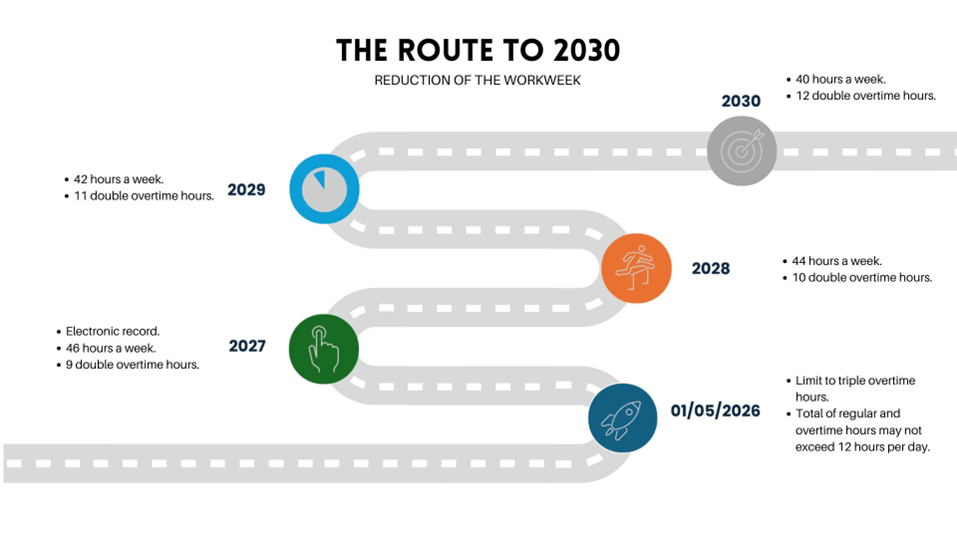
- To reach the 40-hour workweek, the reform establishes a gradual reduction: 46 hours in 2027, 44 hours in 2028, 42 hours in 2029, and finally 40 hours in 2030.
- Notwithstanding the weekly cap, the daily limits remain unchanged: 8 hours for daytime shifts, 7 hours for nighttime shifts, and 7.5 hours for mixed shifts.
- This is particularly relevant given that the combined total of regular and overtime hours may not exceed 12 hours per day, meaning daily limits must still be observed.
- This may also result in different hourly values depending on whether the shift is daytime, nighttime, or mixed.
- Overtime may not exceed 12 hours per week, which can be distributed in up to 4 hours per day, for a maximum of 4 days per week. These hours will be paid at double the regular rate (100% on top of regular rate). By contrast, the current Federal Labor Law allows up to 3 hours per day, no more than 3 times per week.
- However, the above overtime limits will be implemented gradually, as described below.
- Additionally, employees may work up to 4 extra overtime hours per week, paid triple the regular rate (200% on top of regular rate). In total, overtime may not exceed 16 hours per week. It is important to note that there is no transitional provision for triple rate overtime; therefore, the 4-hour limit is already in effect.
- The right to one weekly rest day remains unchanged.
Another key aspect of the reform is the obligation for employers to maintain an electronic record of each employee’s workday, including start and end times, which must be made available to the authorities upon request. The Labor Ministry is expected to issue specific regulations regarding the scope and potential exceptions to this requirement before January 1, 2027. The reform also establishes that such electronic records will constitute full legal evidence, provided they are agreed upon by both the employee and the employer.
Failure to maintain this electronic record may result in fines ranging from 250 to 5,000 times the Unit of Measurement and Update (UMA), which in 2026 corresponds to MXN $29,327.50 / approximately USD $1,689.08 to MXN $586,550.00 / approximately USD $33,781.60. This obligation will become effective on January 1, 2027.
Regarding the gradual implementation of overtime, the following limits for double rate hours are established:
| Year | Double rate hours |
| 2026 | 9 hours |
| 2027 | 9 hours |
| 2028 | 10 hours |
| 2029 | 11 hours |
| 2030 | 12 hours |
In this context, it is essential for employers to implement the necessary operational adjustments to comply with the new legal limits on working hours, as well as to adapt their internal systems to the updated overtime rules. In particular, planning for the implementation of the electronic timekeeping system before January 1, 2027, will be critical.
Additionally, it will be important to review individual employment agreements, collective bargaining agreements, internal work regulations, vacation policies, leave policies, and other documents related to working hours to determine whether updates are required in light of this reform.
As a summary, below is a roadmap toward compliance with the workday reduction:
This alert was prepared with the support of Gabriela Guadarrama García.
The labor and employment lawyers of Basham, Ringe y Correa, S.C., remain for any further comments or questions.
Sincerely,
Jorge G. de Presno Arizpe
David Puente Tostado
Luis Álvarez Cervantes
lalvarez@basham.com.mx